

How to Drift Through the Indie Web Instead of Doomscrolling
There are corners of the internet that still feel alive; you just have to know where to look. A digital dérive with Alex C. from Blog Therapy


You might notice some changes around here, more on that coming soon ꩜ For now, I’ll leave you to enjoy the first ever collaboration on this publication!
I was very lonely growing up. As an only child with undiagnosed AuDHD, let’s just say I had to come to terms with the fear that I might not actually belong anywhere—or at least anywhere I could go at the time. However, once I was older, but probably not old enough to have unrestricted access to the internet, I finally found a place where I truly felt I could be myself. In between my Adventure Time fan account, my attempts at writing fan fiction on Wattpad, and a mildly successful Rainbow Loom Instagram account, I felt so alive—and so did the internet back then.
A few years down the line, the internet felt dead—just as I did. Its state of algorithmic soullessness had seemed to rub off on me and the more I scrolled, the farther I got from that place where I once felt at home. Looking back, though, I was the one who found and created spaces within the internet where I could be myself to the fullest extent of my expression, and not the other way around.
By the time I was old enough to leave my hometown, I had made the choice to move halfway across the globe. I left behind everything familiar because I refused to conform to a life that was not for me, to settle for a world that felt too small. Dare I say the World Wide Web is no different—if you want to discover it, you have to be willing to actually move through it.
In my quest toward figuring out why today’s internet makes us feel so numb—and most importantly, what to do about it—I began exploring the concept of dérive: a Situationist theory and practice developed in 1950s Paris. It was carried out by a group of avant-garde artists and political theorists, consisting of drifting through the spaces between the beaten paths without a destination. This is as a form of resistance against the spectacle-fueled systems designed to keep us on predetermined routes.
How could this logic apply online? I knew the indie web was the perfect place to bring the concept of digital derivé from theory to practice, but I simply didn’t know where to start. That’s when I reached out to Alexandra, a freelance editor and writer covering digital culture, tech, and alternative online spaces. She runsBlog Therapy here on Substack, where you can find essays on these topics, plus regular dispatches from the indie web and interviews with netizens.
Before we dive in, I’d like to share with you how Alex illustrated the essence of the indie web to me:
“The indie web is the orchard that blooms wild outside the gated estate of mainstream social media.”
Alex has worked on indie web-related pieces for New_Public, like this article and this guided tour. She also works with small websites, like Untested, and freelances as a newsletter editor. In her spare time, she’s a voracious reader and urbex enthusiast.
My latest installment of Things To Do Instead of Doomscrolling is live over on Perfectly Imperfect. Titled Giving/Receiving, and very on theme with today's post, I share ways reciprocity has shaped my life lately, on and offline <3
Alex's Guide to the Indie Web
Thanks, Mapu, for reaching out with this collaboration. I love the idea of digital dérive on the indie web because, in my view, they are a perfect match. The alt web was built for purposeful exploration at one’s own pace.
There are many reasons to get curious about what’s out there. Maybe you’re tired of doomscrolling, emotionally overwhelmed by the endless stream of content without context, without a break to digest what you’re seeing. Maybe you want to reclaim your attention span or discover new communities. Here are some great places to get started.
First off, if building and hosting your own site from scratch feels daunting, you can try indie blogging. Some great platforms for this are Pika, Bear Blog, WordPress, Ghost, and, of course, Tumblr (which is now federated). There are also Plume and Write.as, which are both part of the fediverse, meaning you can share your posts across other federated platforms like Mastodon.
All of these sites are free and private, though some, like WordPress, Ghost, and Pika, have paid tiers.
If you are interested in building your own site, there are a few accessible indie options: Neocities, WordPress (again), and Blot.im, which turns a Dropbox folder into a website by dragging and dropping. There is also Are.na, an indie alternative to Pinterest, and HotGlue.me, a visual webpage builder.
Either way, this is a good explainer of what a website is, how to build it, and what tools you can use. And the 32Bit Cafe has a comprehensive resource list broken down by skill level and how involved you want to get.
You can probably vibecode a site using something like Claude, but I wouldn’t recommend it. Instead, it would be very indie web, very punk, to try and pick up a new skill and make something with it from scratch.
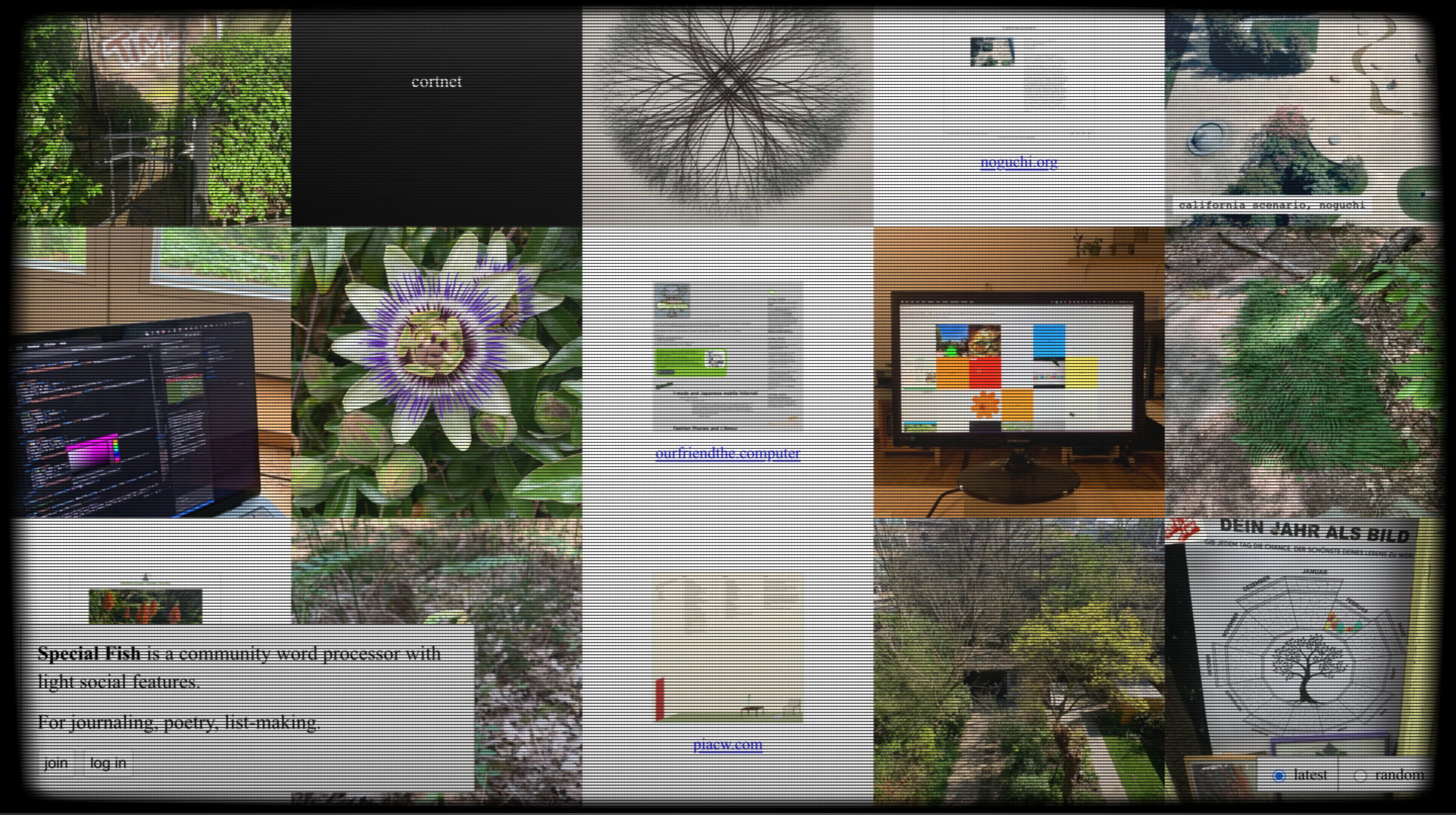
Another important part of indie web infrastructure is the webring—a collection of sites organised in circular fashion, usually around a specific topic. This is one of the easiest ways to surf the alt web in search of new haunts. Some good ones to start with: this directory from IndieWeb.org (a fantastic resource in its own right), this list of webrings grouped by active/inactive sites, MelonKing’s Surf Club, and this Neocities webring.
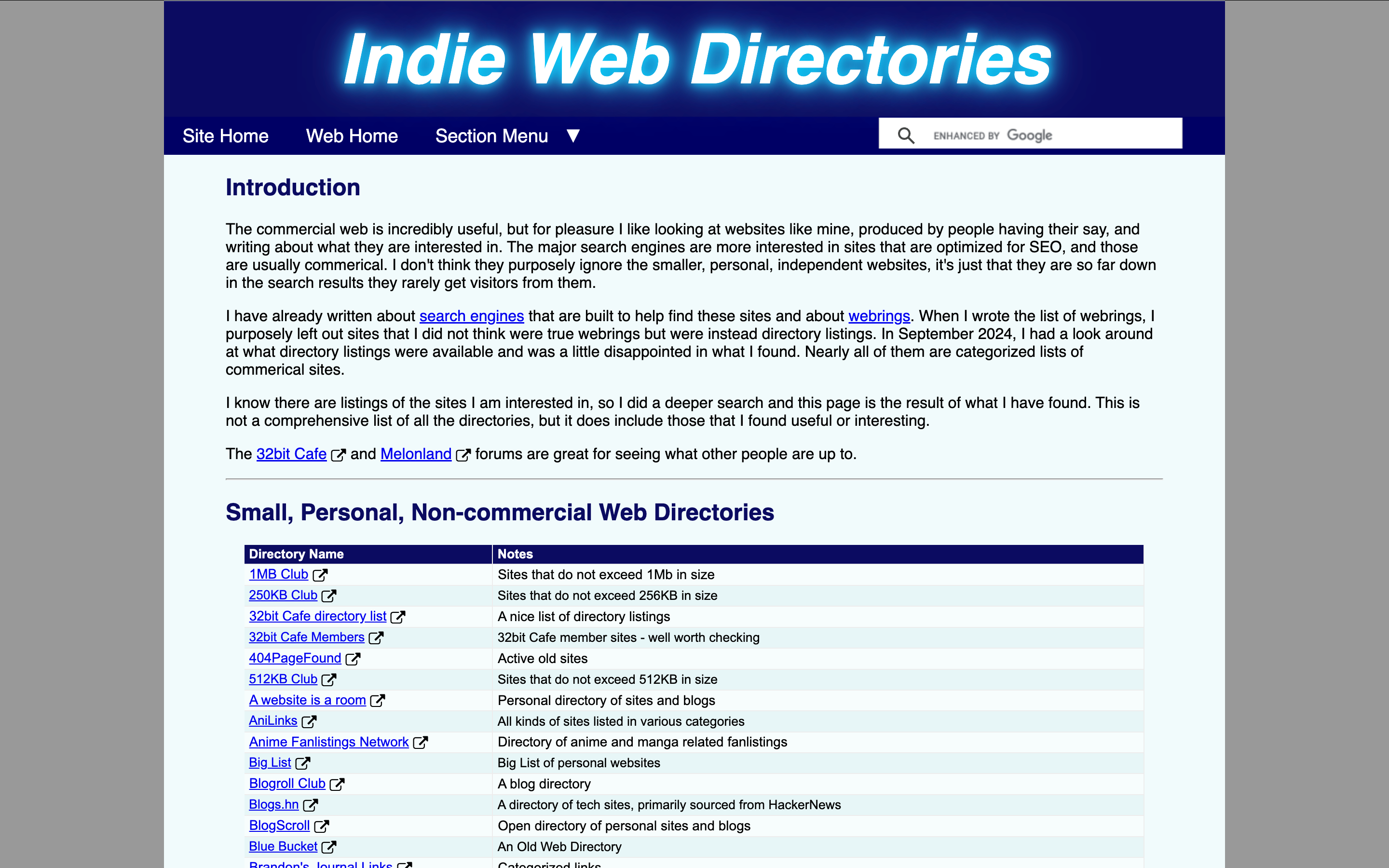
There are also site directories, like this explorer from Marginalia.nu and this giant list from Bisray. Many personal sites also have a friends & recommendations sidebar, like the one on Kicks Condor’s site (on the righthand side as you scroll).
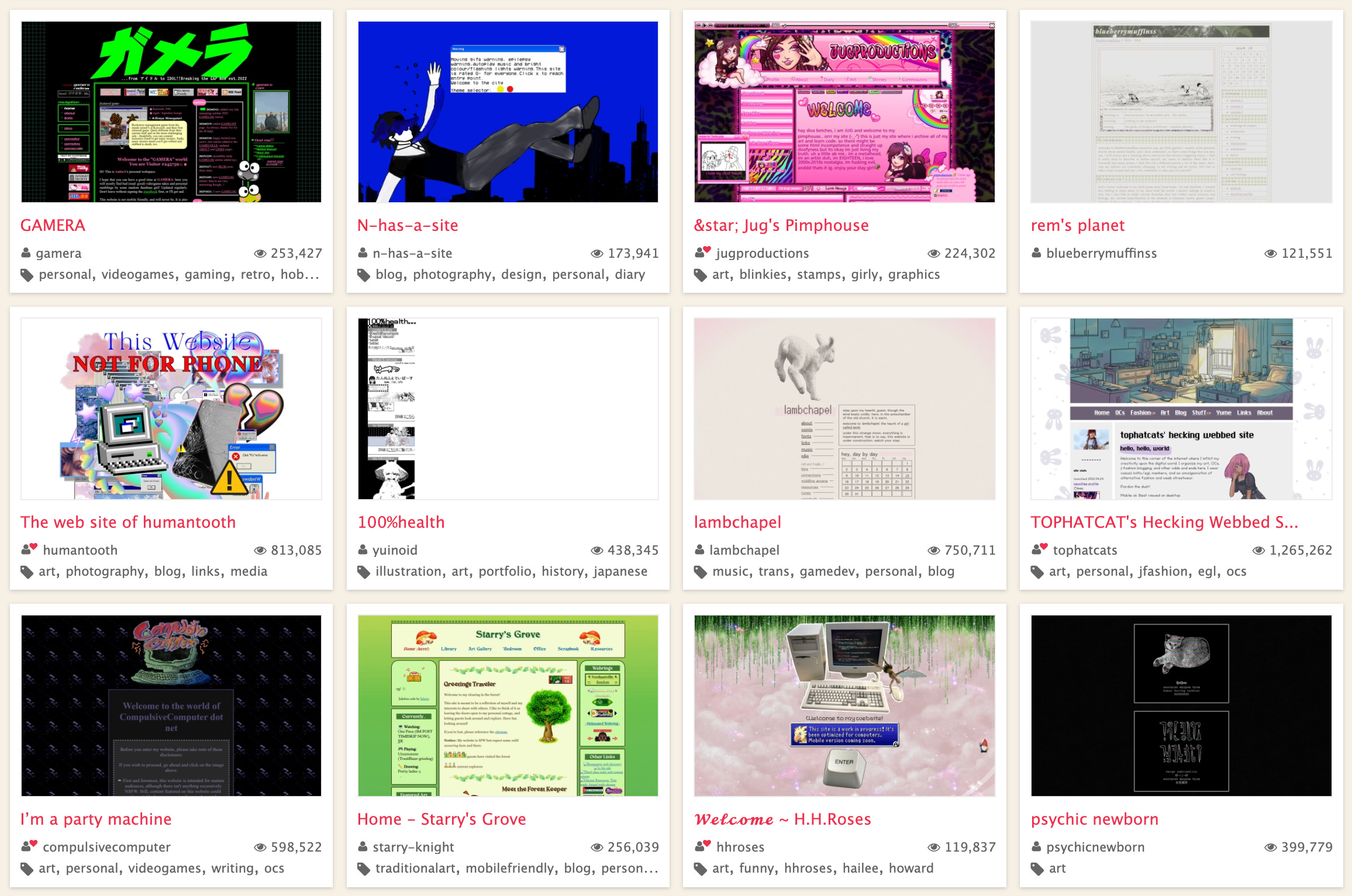
Some cool sites to inspire you include the aesthetically lush Satyrs’ Forest, the whimsical Olliveen, and this point-and-click SciFi novella.
But not everything on the indie web is a high-octane, visually ambitious art project. There are also personal sites and blogs where people talk about their day, gush about their new puppy, and post earnestly about their passions.
What Does Digital Dérive Actually Look Like?
After speaking to Alex and getting all of these wonderful resources, saying I was excited is an understatement. In fact, I don’t think words are enough to explain what this journey was about.
Before I sat down to spend my evening drifting through the indie web, I had this idea that I would walk you through the places I found in a linear way—showing the start and the destination, describing what each place was about. But the second I actually began jumping from one link to another, that hyper-structured vision fell apart.
At the end, I had countless saved links and no idea how to share them in a way that made sense. After giving it far too much thought, I realized the answer was right in front of me the whole time—I could make my own website and simply share them there. Easier said than done, but after the many hours of trial and error that any new skill requires, I created my own little corner of it on Neocities.
I approached this as an art piece, curating a selection of places that genuinely sparked something within me. Against all of my instincts to always provide precise and detailed descriptions, I gave myself the task of expressing what that spark looked like—restricting myself to just a few words per line. Without further preamble, here it is:
This took so long and I’m very proud come check it out
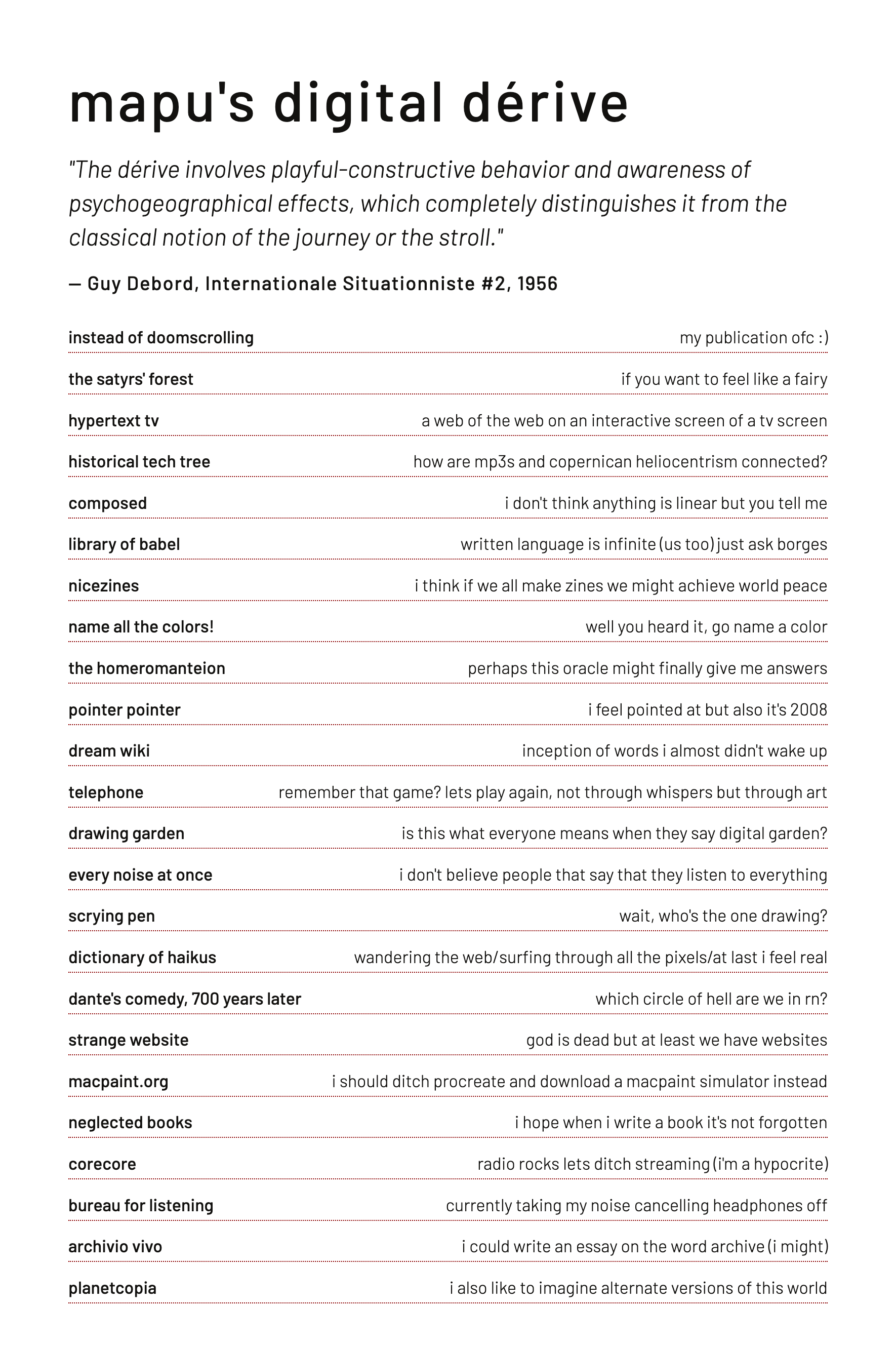
This was one of the most challenging yet rewarding creative projects I’ve done in a very long time. I particularly love how minimal it is—it directly opposes what I’m used to doing when I share media with you. Beyond visuals and long, detailed reflections, it’s about finding creative ways to spark curiosity without them. This is definitely a work in progress, but I’m excited to keep adding to it :)
I’d like to conclude this section with the haiku I wrote to accompany the dictionary of haikus—because in essence, it captures this whole experience far more efficiently than I’m trying to here.
wandering the web
surfing through all the pixels
at last i feel real
Your turn to write one ꩜
Shared Reflections
On the perception of digital spaces: indie web v.s. mainstream media
We tend to have very black-and-white thinking when it comes to seemingly opposing concepts. It was challenging for me to visualize how the indie web and mainstream media platforms could coexist in the same space. When I asked Alex about her thoughts on this, she said that the indie web makes the online world feel bigger and more expansive. This doesn’t mean that it’s a replacement for mainstream social media, but it’s definitely an important part of a balanced media diet. I concluded that digital spaces are built mostly through our perception of them, so if we see them as separate, rather than a web of connections, there is no way to move between them and find genuine balance. I do believe it’s important to remember what makes these two different:
“The indie web is a space for curiosity, creativity, and autonomy, where you don’t have to put up with unsavoury tradeoffs just to participate (unlike on Instagram, TikTok, etc., where you have to hand over your personal data, your attention span, and even the rights to what you post). And there is a welcoming and active community, which has been growing over the past few years.”
The community aspect is the absolute highlight of the indie web to me. Alex spent last summer writing an intro to the indie web for New_Public and interviewed a bunch of people who host their own sites. She told me about how much she enjoyed their answers and insights, which just seems to echo my sentiment—one of her favorite responses was from the creator behind MelonKing, who called this period of rediscovery the “web revival”, a nod to the American Folk Revival. You can find some of these interviews up in full on Blog Therapy, and make sure to check out the latest one :)

On the indie web and dérive as resistance
Ever since I started to actively try to improve my so-called “social media addiction”, I’ve just naturally made this move from subconscious to conscious awareness of the larger issue at hand, and in turn, have organically found myself in some corners of the indie web by drifting from link to link. I was and am still active on mainstream social media because I couldn’t look past the fact that, despite its many flaws, it could be used for good, and ultimately, that was how it was possible for me to build this space.
That’s why it actually felt refreshing when Alex pushed back on the concept of social media addiction. When I brought it up, she mentioned she finds calling it an addiction perpetuates misconceptions about the gap it’s attempting to fill—especially for young people. She then posed the following questions:
What if it’s actually an imperfect solution to a much bigger problem?
What if we’re chronically on social media not because of addiction, but because that’s where everything and everybody is?
She points out how these platforms monopolize and control our lives to the point that the real world is online now—for most, this means just a few apps run by the same three mega corporations.
However, she also brought up the point I mentioned earlier on, reframing our view of social media to foster community and resistance by highlighting all the fundraisers, protests, garage sales, buy-nothing groups, and marches organized via Facebook, Instagram, WhatsApp, etc.
To actually drive significant change by using social media as a powerful tool of connection and resistance, though, we must understand at a large scale that the loss of agency and attention are just the tip of the iceberg—mere symptoms of a much more complex underlying issue. Alex illustrates this very clearly: “Consider that when an authoritarian regime wants to hide what it’s doing to their own people, they cut off internet access. Because social media can be an impartial tool for truth-telling and democracy.”
Rather than dwelling on the impending doom that we’ve gotten used to, what if we stop waiting for someone else to do something about it and start with what we can actually control? That’s why I wanted to explore dérive in the first place, but without an infrastructure, that wouldn’t be possible. The indie web and the web revival at large IS the infrastructure—it’s “an online world that’s way more diverse, much broader, more privacy-friendly, more welcoming to creativity, self-expression, and autonomous exploration.”
On accessibility and getting started
When I asked Alex about the shifts she believed need to happen to actually make the indie web more accessible, and a genuine alternative to doomscrolling, here’s what she answered:
Practical: “Many non-technical people are intimidated by the idea of building and hosting your own site. We need to build awareness about the existing options (some of which I mentioned earlier on) and work to create newer, better ones. Starting a site or blog shouldn’t be any more complicated than getting Gmail set up.”
Psychological: “We need to move away from passive consumption to (pro)active discovery and outreach. Many of us just aren’t used to that anymore. On mainstream platforms, you don’t need to go looking for your interests, your people; the algorithm narrows down the content you get until it’s just right. This is convenient, but it also dulls curiosity and takes away our intellectual autonomy, our ability to discern about the content we consume”
Personal: “It’s reclaiming our curiosity, our interests, and our desires. This requires a level of autonomy that’s incompatible with mindless doomscrolling. If you want to make the most of the indie web, you need to get back in touch with your interests, forget about being cringe, and follow your curiosity (online and off). There’s a powerful resistance here and I think a lot of us would benefit from it.”
Even though I was already familiar with some places on the indie web, a few of which I’ve shared with you previously, I had only scratched the surface. I wanted to show you how I practice what I preach by fully immersing myself in these spaces through the frameworks that resonate with me: curiosity-led research and consumption turning into creation. Regardless of all the challenges I faced during this project and the shifts that still need to happen—both personally and at large—it was more than worth it and I’m glad that I picked up a new hobby in the process.
I truly want the internet to feel alive and expressive rather than oppressive for more than just a few. My goal is always to make these shifts more accessible and achievable for as many people as possible, so I hope this piece tips the scales, even if just a little, toward a more creative, inclusive, curious, and indie future.
Some closing words from Alex on how the indie web has impacted her life:
I’m excited about being online again. Working in media for almost a decade now, I got pretty cynical about what’s out there. Sure, there was my work as an editor, and that was mostly fun (especially on the digital culture news desk), but the internet seemed to be shrinking.
But getting into the indie web, the online world seemed to grow again. I think a good comparison is hopping off the guided tour to get lost down random side streets and alleys instead. Wandering based on curiosity and intuition rather than being led by the hand to my next destination.
It’s really put me back in touch with my interests. Now, when I’m on Instagram for too long, I start to feel a bit dead inside and log off to play with my dog or something.
A big thank you to Alex for agreeing to be a part of this very special project, everyone please go send her some love!
Sending love to all of you who made it all the way here, I’m excited to share more upcoming collaborations and I hope you have lots of fun on your own digital dérive :)
Writing to you from my bed with my emotional support fidget egg,

Here are some ways to contribute to this community in any way you can꩜
If you have any cool websites you’d like to share with me, or just want to say hi and have a chat, just reply to this email, I’d love to hear from you <3
 | A guest post by
|
So proud to have been the first collab on your newsletter! It's been a joy working on this project <3
You know, I've tried getting into the indie web a few times. I love the spirit of anarchism, creativity and personal expression that lives in it.
However, any time I looked at these websites I think to myself: "Hey, this is cool and nothing about it interests me.". I love those personal blogs where a nerd talks about a specific problem I am currently having, e.g. in programming. But other than that.. I don't know.