

Media To Consume This Week Instead of Doomscrolling: Between Comfort & Discomfort
Notes on mysteries, feeling human, comfort, failing, social friction, self-reliance, disconnection, and more.

Welcome everyone to this week’s media roundup! As the new year draws closer every day, I’ve been thinking about the growth that I aspire to continue experiencing next year. Whenever I feel like I’ve grown through knowledge, relationships, experiences, or reflections, a sense of comfort fills every last corner of myself. However, the hard truth is that, to get there, you must endure the discomfort of growing pains. Finding a balance between the two isn’t always easy, but this week’s pieces certainly served as a guiding light as I get ready to embark on new journeys, so I hope they can do the same for you :)
Navigating the Mysteries on Emergence Magazine
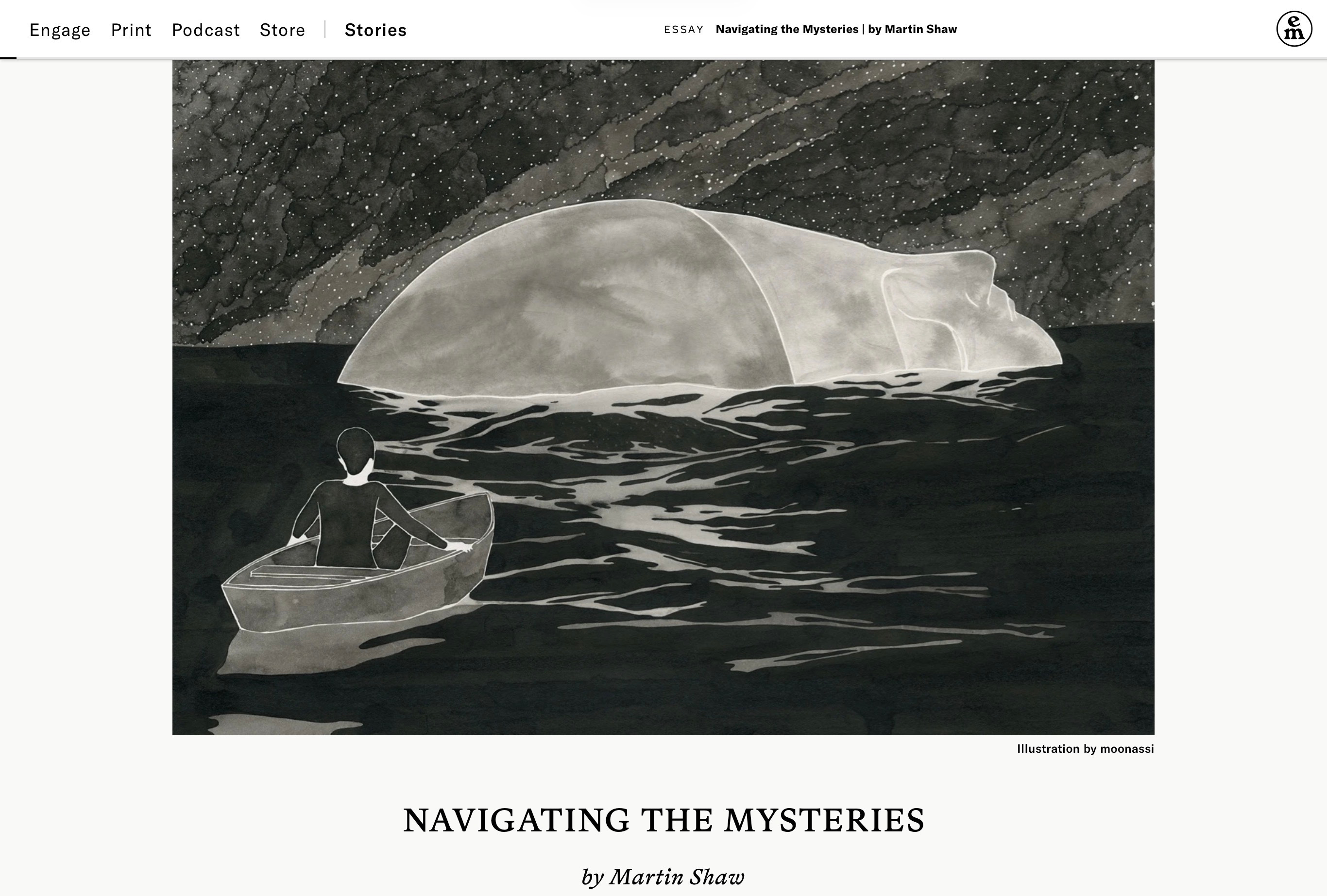
Essay arguing that uncertainty must be navigated through mythmaking rather than punditry—creating stories to create meaningful engagement with mystery can allow us to navigate ambiguity by cultivating richness, wonder, and authenticity.
Being back home in my childhood bedroom feels like stepping into a portal that can bend the space-time fabric, allowing me to simultaneously see the many versions of myself that have existed within these four walls. I look at them and see how I have always had a rebellious tendency, this inherent impulse to question everything around me, but when I realized that this often brought me trouble so I tried my best to shut it down. Over the years, this repression turned into certainty—I now see how skepticism and stubbornness kept me stuck in loops of self-limiting beliefs. I was convinced that life existed at face value, that I was bound by the realities that everyone projected onto me.
The moment when all this pressure was finally released was in my high school philosophy class, where not only was questioning everything accepted, but it was also encouraged and even rewarded. A central theme explored in this class was Greek mythology. At first, I thought these stories were slightly ridiculous yet entertaining, but eventually, as I began analyzing and dissecting their symbolism, my world was infinitely expanded. Every myth—as fantastical as it was—gave me a framework to not only navigate the paradoxes within myself, but to pull me out of my head and place me in a context to embrace the mysteries in the world around me.
As I went down this memory lane, I came across my final essay for the subject; it was about the origins of Greek mythology and their social, political, and theological implications across time. I hadn’t read it in years, but looking back, it was a seed that bloomed into the way in which I understand the world around me. Through a lot of deconstruction and humility, I’ve learned to step out of dogmatic belief systems and embrace storytelling in the way I choose to write the narrative of my life. I’ll leave you with a quote from the closing paragraph of this very essay:
“I learned how valuable it truly is to immerse oneself in a story, since one never really knows what worlds of ideas and reflections could be discovered.”
Things To Do Instead of Doomscrolling - Feeling Human
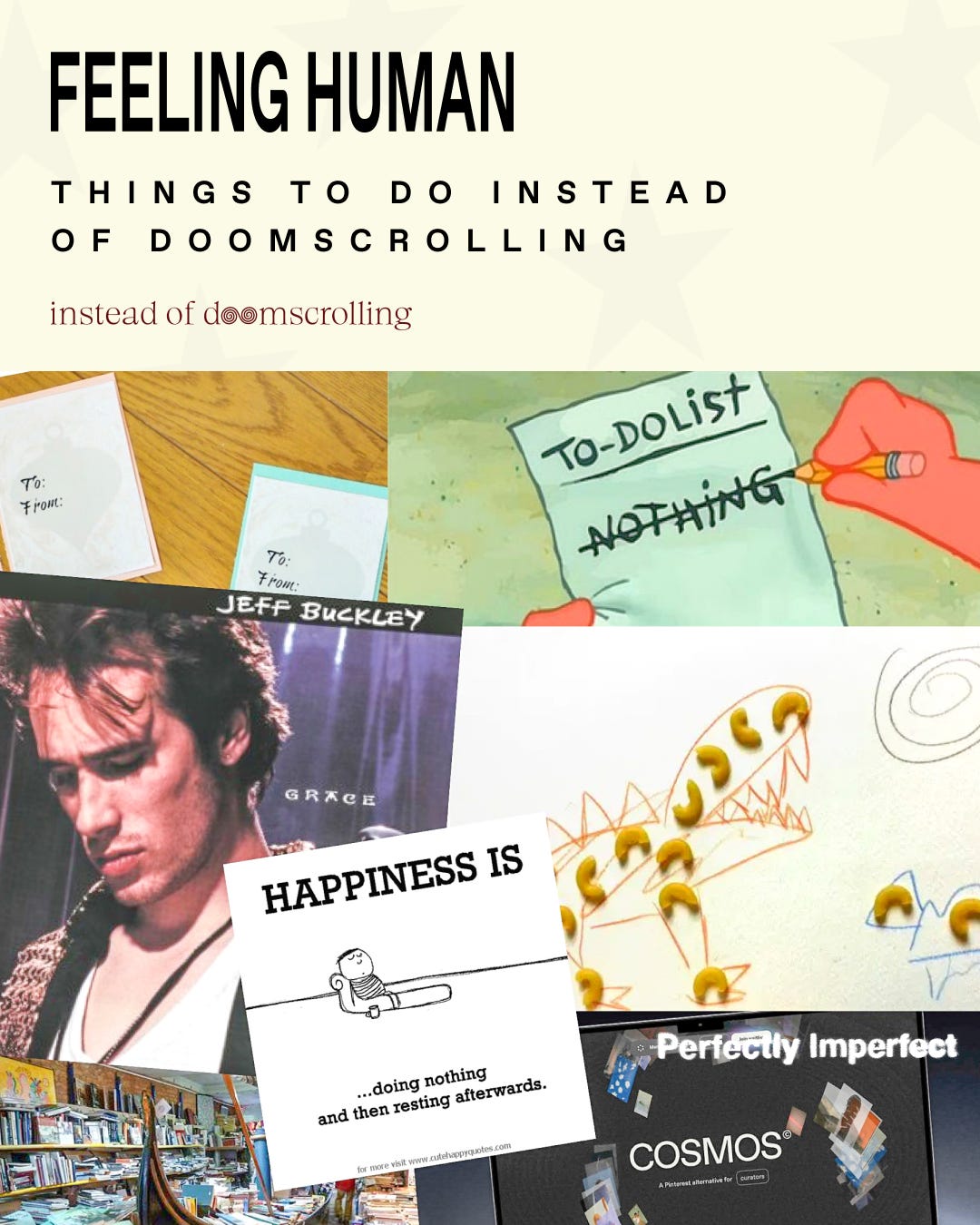
Recommendation list created by me, where I share things to do instead of doomscrolling such as activities, books, shows, films, fun corners of the internet, and more :)
Here is the intro to this week’s installment:
If I could describe this past year in one word, it would be uncanny. With AI seeping through every crack of our lives, headlines that read like fever dreams, and the algorithmic flattening of identity—and honestly, I could go on—everything seems to be glazed by a layer of synthetic static. This feeling has led to a collective detachment and isolation, pushing us even deeper into our individualistic holes. That’s why it’s more important than ever to remind ourselves of the unique qualities that make us human. As a way to ground myself in this strange moment in time, I have made a conscious effort to embrace the connection with my own humanity and that of others, because that’s the only way we will remain as one.
Podcast exploring the concept of comfort and discomfort through the lens of certain philosophers across history, and how these can be understood in a contemporary context.
“Comfort lies at the edge of awareness” is a quote that kept buzzing in my head even long after I finished listening to this podcast—it led me to question the concept of awareness itself. Is it an oxymoron to say that we aren’t necessarily aware of what we are aware of? Maybe. My point is that perhaps, only once we accept the discomfort of the unknown, we allow for clarity of what is and isn’t held by the bounds of our awareness—of what the terrain of our comfort zone actually looks like.
This idea of understanding the self through edges has been fundamental to my growth over this past year. I remember I drew a couple of diagrams that helped me make sense of this concept a while ago. Funnily enough, the very evolution between one diagram and the other paralleled the one of expanding my comfort zone through an exploration into the unknown. The first diagram was drawn at the moment in which this idea came to my mind, and the second, once I had made room for uncomfortable concepts and experiences to develop the initial thought:
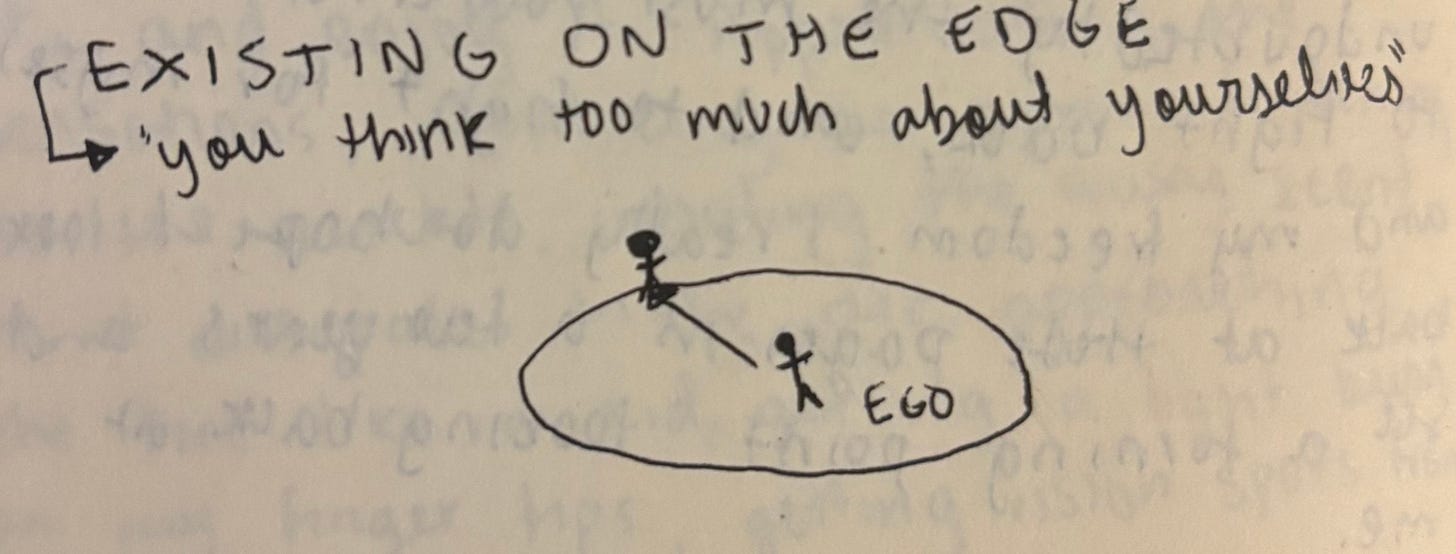
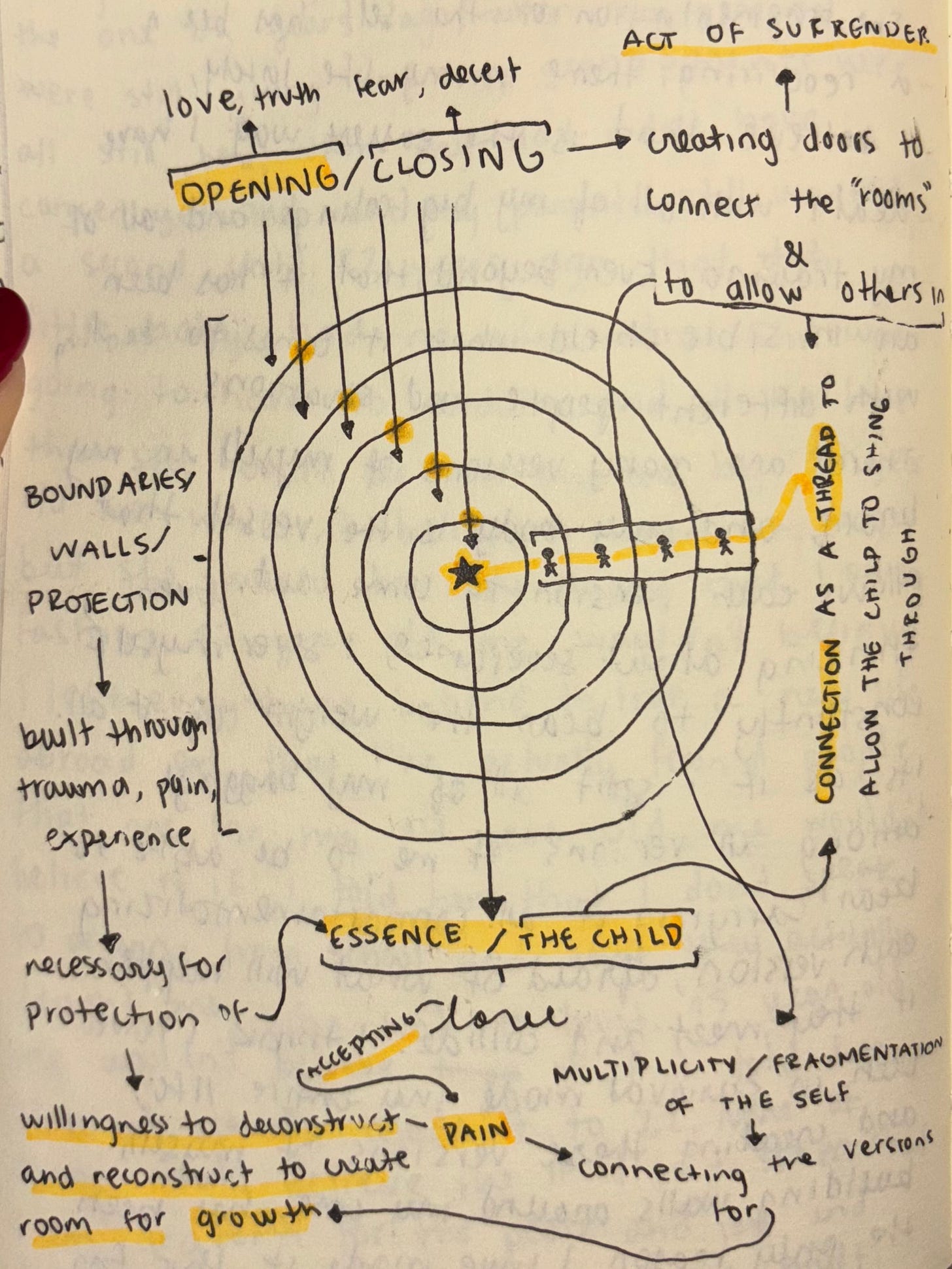
I’m not sure if these will make sense to anyone other than myself, but I wanted to illustrate how pushing our boundaries creates expansion. For me, this process wasn’t easy, but figuring out how to get to this edge has definitely been worth it.

Substack post analyzing the fear of failure and exploring how this very feeling can be cultivated to provide growth rather than defeat or stagnancy.
You know that 3 am urge to change your life the following morning, the feeling that this time around things will be different, and you’ll actually follow through with it? I noticed that when that happens to me, it feels realistic because I am in a state of isolation. The darkness, the silence, the slight delirium of exhaustion make me forget that if I were to actually try, I would need to be seen trying—the fear of being seen trying and failing slips from my mind.
I’ve thought a lot about what failure means to me and the feelings that it raises. One of my best and worst qualities is my incessant perfectionism; this need to do something flawlessly or simply resign to not do it at all. Once the morning comes, so does this need, the noise, the light, the clarity remind me that I exist in a shared context—I shelter in fear, away from a sort of self-constructed panopticon.
Even though fear is uncomfortable, we find comfort in it because of its vastness, its stability, and its familiarity. It’s like staying in a toxic relationship because we would rather endure that persistent discomfort than find out the one that comes with being alone. It eventually becomes a baseline; it becomes unfathomable to conceive a life without it, but it keeps you stuck. We settle for fear because it’s familiar, but behind this mirage of stability is just stagnation. To grow, we have to be willing to be seen trying—and potentially failing—even when the sun comes up.
The Healing Power of Social Friction on Noema
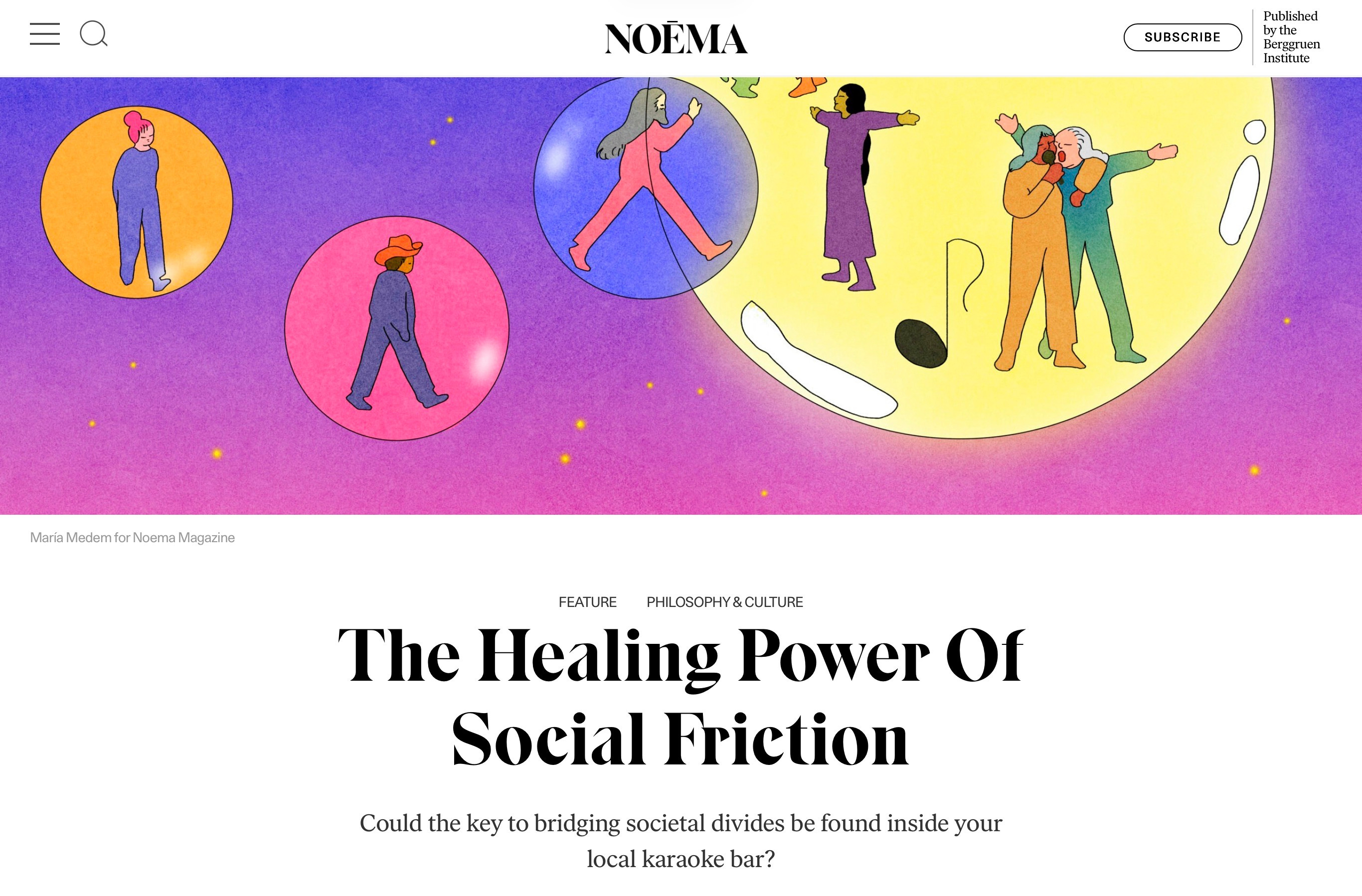
Essay arguing that social friction—under controlled circumstances—can be deeply constructive and transformative. Through the story of a karaoke bar, we see how bridging divides and expanding empathy by engaging with different perspectives can promote a healthy, functioning democracy.
This piece reminded me of those nights out where it feels like you’re in a fever dream, encountering almost caricature-like characters, where nothing feels quite real because you step out of the predetermination of your perception of reality. You exchange glances, toasts, and words with people that you would have never come across otherwise. Dim lights seem to blur boundaries, and everyone suddenly has their guard down; conversations flow in a way that would hardly ever feel natural in any other place.
I treat these types of nights out as field studies, dissecting every interaction to try to understand other people’s points of view. More often than not, I encounter people whose reality is entirely different than mine, and even though I can be quick to judge, I take this as an opportunity to participate in constructive discussions. Even though these interactions are fleeting—and often uncomfortable—they have allowed me to become a more empathetic person and see the nuances that lie beyond the rigidity of the things that separate us once the sun starts to rise.
Visual video essay exploring Emerson’s concept of self-reliance, highlighting the role instincts play within the tension between external validation and the innate inner voice that responds to it.
Does essence precede existence, or does existence precede essence? This is one of the age-old questions that philosophy and religion have attempted to answer across centuries and even millennia. I’m not here to attempt to answer it, but rather to nudge you to ask yourself where you believe your sense of self comes from—and I think this video is a great place to start.
I’ve said it a million times and I’ll say it again: we do not exist in a vacuum. We are exposed to endless stimuli; through the senses, we receive constant information. But what determines what makes a lasting impact and what doesn’t? It’s easy to accept whatever seems strongest, loudest, or brightest; these catch our attention, and we accept them for the sake of conformity. Our inner voices get muffled and we lose faith in ourselves. We forget that the most important voice is not always the loudest one, but the quiet one that evokes a feeling of genuine comfort and trust.

Essay exploring how we create alternate versions of ourselves and our lives in search of a sense of oneness in our inherent otherness, attempting to close the space between others and ourselves through internal projections.
A coping mechanism I’ve developed throughout the years is creating alter egos of myself—I suppose I could call these mirror-selves. When I began to realize how disturbingly alienated I felt from everyone else, I started to clone myself to try to fill the holes made by the things that I didn’t have. This multiplicity eased the perception of otherness from the people around me, but exacerbated the one I felt within myself. The price of blending in for the sake of other people’s comfort was losing my own sense of self.
Not long ago, I was talking to my best friend and told her that I feel like Hannah Montana—leading a sort of double life where I’m kind of a loser in one and a superstar in the other. This superstar alter ego is magnetic and charming; she can get anything she wants and everyone around her will make it happen. She always knows exactly what to say and to whom. She rarely ever comes out anymore because she’s not real; she’s an illusion, one that can be seen through if stared at for a bit too long.
Being her brings temporary relief but lasting emptiness, so I’ve tried to embrace other versions of myself—ones that feel more real, even if they’re not. As I’ve come to terms with my inherent otherness, especially after figuring out that I’m neurodivergent, I’ve slowly started to narrow down my mirror-selves in an attempt to figure out which one is actually me, rather than just reflections of the things I lack.
Here are some pieces from the archive you’ll have full access to if you decide to join:


I feel like I need to tap into myself more because the what feels like limited in scope now has a expansive abyss staring at me echoing to go deeper. Love this
I remember saving some of Horses videos from a recs list you madr once, and now I just remembered I haven't watched any yet 😭 This must be my sign to do so finally.